Now that PNC acquired FirstBank, we are facing a huge loss in loan officer training programs for new graduates. Annually the bank hired dozens of talented college grads to enter their robust training program which included lending, financial analysis, operations, and personnel management. FirstBank was a large community bank and focused on CRE lending.
One of the most common questions I hear from commercial bankers, especially early- career lenders and relationship managers—is:
"Which banks still provide formal credit training?"
In today's market, banks are hiring experienced talent aggressively, but fewer institutions are willing to invest in developing bankers from the ground up. That makes organizations with structured training programs increasingly valuable. Formal credit training doesn't just teach financial analysis—it builds future leaders, improves credit quality, and creates stronger retention.
While programs evolve over time and vary by market, these organizations have built reputations for investing in lender development:
One of the CBA's flagship educational initiatives is the Graduate School of Banking at Colorado, a three-year graduate-level banking school that focuses on:
Does not offer a formal credit training program but does offer many other development programs including
Formally known as Omega Performance, is one of the most widely used third-party commercial lending and credit training providers in the banking industry. Since 1976, Omega has provided credit training programs to community banks, regional banks, and large financial institutions around the world. Many banks use Omega as either their primary analyst training program or to supplement internal credit training.
Moody's Corporation
Risk Management Association (RMA)
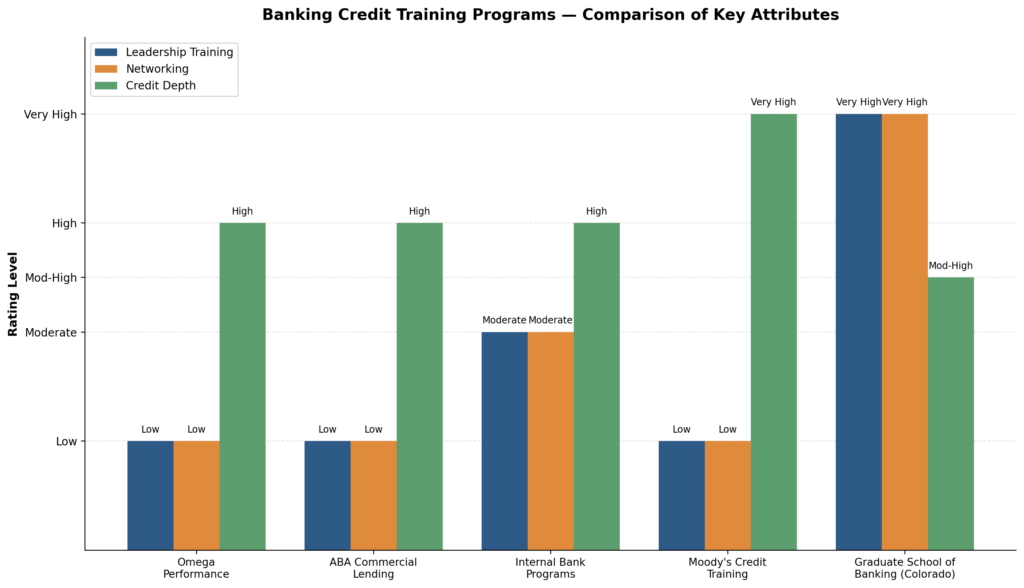
Banks that invest in training programs often:
✔ Build deeper benches of future leaders
✔ Experience stronger employee retention
✔ Create better credit discipline and consistency
✔ Offer clearer career progression for ambitious bankers
As the banking industry faces succession challenges and figure out AI, institutions that continue building talent pipelines may have one of the biggest competitive advantages over the next decade.As the banking industry faces succession challenges and figure out AI, institutions that continue building talent pipelines may have one of the biggest competitive advantages over the next decade.